Uncategorized

Thinking of Putting Your Home For-Sale-by-Owner? Here’s Why You Might Want to Think Twice.

Homeowners obviously know their homes better than anyone, but that doesn’t mean they’re the best salespersons for their properties.

Some sellers are tempted to try a For Sale by Owner (FSBO) transaction because their local community is in the midst of a sellers’ market and they think they can sell easily without help. Others try the FSBO route because they want to maximize their profits and avoid paying a commission to a Realtor.

However, statistics show that selling your home with the assistance of a professional real estate agent will garner you a higher profit, enough to cover the commission as well as put more money in your pocket. According to the National Association of Realtor’s 2013 Profile of Home Buyers and Sellers, the average FSBO sales price was $174,900, while the average price for a home represented by an agent was $215,000, a difference of $40,100, (obviously not the Stamford area but the numbers are still meaningful).

Why to Sell With a Realtor

Choosing to sell with a professional rather than on your own makes sense for a variety of reasons:

  • A Realtor has access to market data about recent sales and other homes on the market that can be used to price your home appropriately. Studies show that homes priced right when they’re first listed sell more quickly and for a higher price than those that linger on the market.
  • A Realtor can have your home available to be shown when you aren’t available (see the next bullet point), can respond to inquiries from potential buyers and their agents, and can get valuable feedback from visitors – all things that save you time.
  • Buyers typically prefer to look at a home without the seller present so they can feel more comfortable exploring the rooms and visualizing themselves in the property. At an FSBO sale, the seller must be present.
  • A Realtor can look at your home objectively and suggest ways to improve its appearance – by staging and minor repairs – so it appeals to more buyers.
  • A Realtor can screen visitors to your home, which provides a measure of safety that FSBO sellers don’t have. In addition, by checking to see if the buyers are legitimate and can afford to purchase your home, a Realtor can help you avoid wasting time showing your home to unrealistic buyers.
  • Realtors have professional marketing expertise, contacts with other Realtors who work with buyers (the Greater Fairfield County MLS has approx. 8,000 members!), and the support of a brokerage that can market your home more widely than you can as an individual.
  • A Realtor can help you negotiate a contract that not only garners you an appropriate price for your home, but that meets your needs for a settlement date.

FSBO Dangers

Most buyers today work with a buyers’ agent to represent their interests. If you choose to sell your home on your own, you’ll be negotiating with a professional and relying on your own skill to finalize a contract. Not only could you end up selling your home for less money, you could leave yourself open to potential legal problems.

FSBO transactions can be successful, of course, but 90 percent of homeowners prefer to work with a professional rather than risk an unsatisfactory home selling experience.

Call me and let’s discuss what could work for you.

Standard
Uncategorized

Homeownership’s Impact on Net Worth

Over the last six years, homeownership has lost some of its allure as a financial investment. As homeowners suffered through the housing bust, more and more began to question whether owning a home was truly a good way to build wealth. A study by the Federal Reserve formally answered this question.

Some of the findings revealed in their report:

  • The average American family has a net worth of $77,300
  • Of that net worth, 61.4% ($47,500) of it is in home equity
  • A homeowner’s net worth is over thirty times greater than that of a renter
  • The average homeowner has a net worth of $174,500 while the average net worth of a renter is $5,100

Bottom Line

The Fed study found that homeownership is still a great way for a family to build wealth in America.


courtesy of 

Standard
Uncategorized

Is The Customer Always Right?

Real Estate is a service oriented business, where our job is not to make the decisions about buying and selling a home, but to help guide our clients in making the best decision for themselves.  Sometimes this involves giving unpopular advice but I consider my job to try to keep my clients objectively focused on their ultimate goal – buying or selling a home.

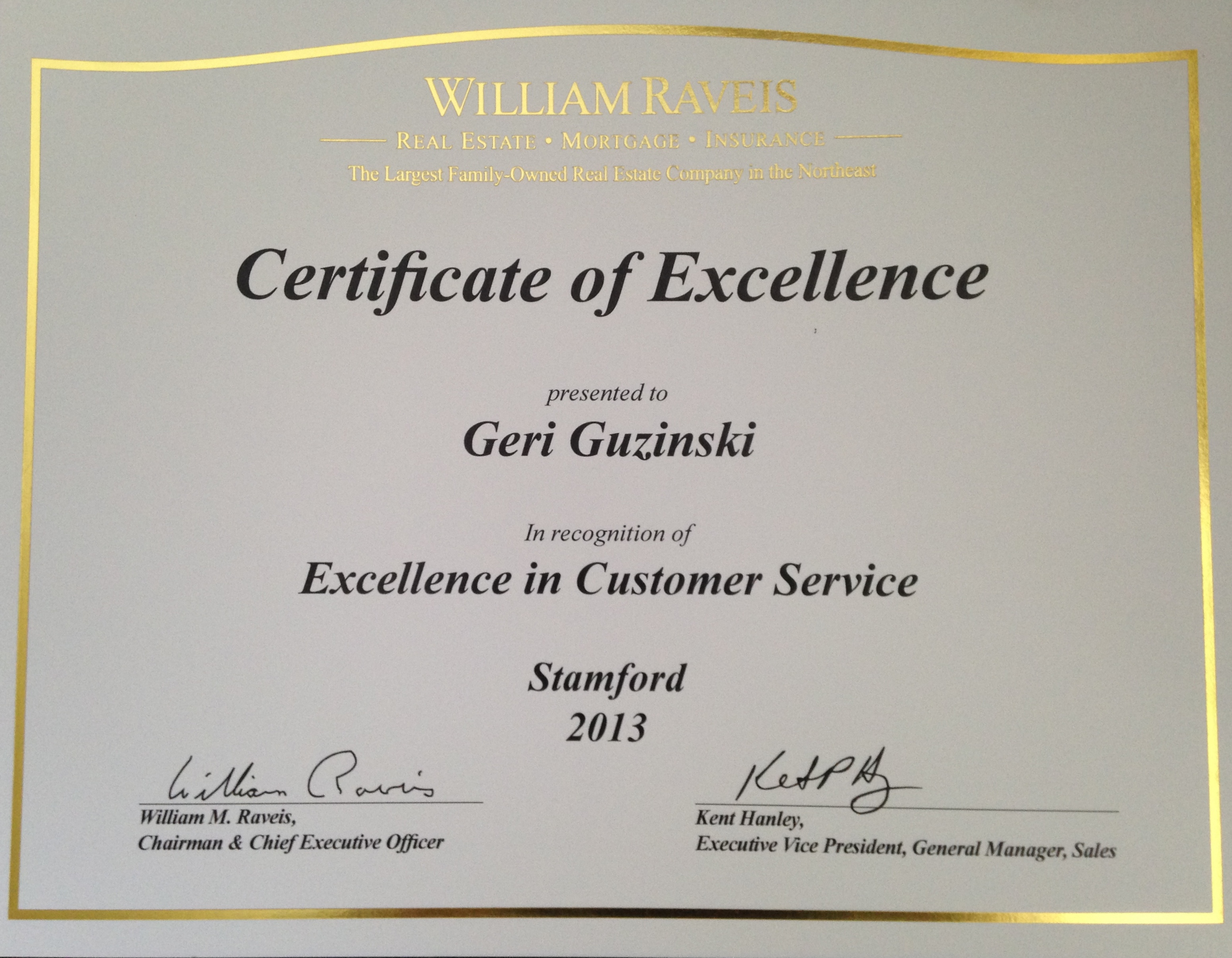
My philosophy has always been to offer the best service that my 28+ years of real estate experience allows me to share.  William Raveis Real Estate shares the same philosophy, that our client comes above all else.  I take pride that at the end of our transaction when William Raveis sends the customer satisfaction survey, the majority of my clients take the time to fill it out and send it back.  The feedback is invaluable and I’m happy to say that I was just honored to receive the
“2013 Excellence in Customer Service Award” for our Stamford offices.

Cert 2

So, is the customer always right?  I defer to Stew Leonard, who has a big sign at the entrance to his stores that says:

Rule #1  The Customer is Always Right

Rule #2  If the Customer is Ever Wrong, Re-Read Rule #1

  Call me and let me help you make the right decision!


Standard
Uncategorized

Off-Market Listings Only Reduce Profits for Home Sellers

What is a “Pocket Listing”?  This is a listing where a homeowner lists with an agent but they do not put the home out to the whole brokerage community through the multiple listing system, literally keeping the listing “in the pocket of the listing agent”.

Off-market, private, or pocket listings are becoming more commonplace.   Some sellers are being persuaded to keep their properties off of the Multiple Listing Service  during what is starting to become a hot real estate market with low inventory.  Generally sellers are being told that by keeping their property listing “private” their privacy will not be invaded by troops of public gawkers traipsing through their homes, and that they will not have to hassle with signs, lock-boxes, and agents showing their homes, etc. Whatever the rationale being sold to some sellers, it is unfortunate because they are unknowingly leaving large percentages of potential profits on the table. It seems that  some brokers/agents whose integrity might be called into question, are playing coy and first gaining the sellers’ confidence and  then encouraging them to keep their property off the Multiple List Service (“MLS”).


Let’s look at what  an agent’s motivation might be.  The claim that some brokers and agents are using to convince sellers to have a “private” or “pocket” listing/sale is to guarantee buyers to their clients. However, in a lot of instances those guaranteed buyers are coming from the broker’s and agent’s own offices or circles of close friends which dramatically reduces exposure to the marketplace, but allows for the brokers and agents to possibly double-end the transaction, or “keep the whole deal in the office.”


What they also fail to tell unsuspecting sellers is that exposing the property on the MLS places it in front of over 8,000 local networked broker and agent members, all of whom then have the possibility to work with the property. Limiting exposure to the MLS is by definition limiting the marketability of the property. And coincidentally these “private” or “pocket” listings are common when the real estate market heats up and there is limited inventory.


It is a violation of a listing broker’s fiduciary duty to the seller to keep the home off the MLS unless the homeowner, after being fully and faithfully informed, has a legitimate reason for not marketing the property to all brokers and agents in the MLS. It is always in a seller’s best interest to have a massive advertising of a home, which encourages and promotes bidding wars and greater sales prices. Sellers who are convinced to have an “off-market” listing probably do not recognize the advantages of placing their home on the MLS, so they acquiesce and go along with their broker or agent’s recommendation based on guarantees from their broker/agent that they will get either equally as good a sale price by doing so with less hassle.


Brokers and agents have the duty to exercise care, integrity, fair-dealing, and loyalty for their customers. This task consists of performing their best possible acts and conduct to acquire the greatest sales price for the home. Recommending “private” or “pocket” listings is typically NOT in a seller’s best interests. There are however exceptions or rare occasions where these type sales make sense for sellers, but they are extremely rare.

The MLS was designed to subject properties to maximum exposure leading to a maximum sales price for the specific timeframe. Leaving a property off of the MLS dramatically limits exposure – doing exactly opposite of what a seller should be doing.

The brokers and agents who recommend “private” or “pocket” or “off-market” listings should be held to answer with specific reasons and factual details for this recommendation and be asked to provide verifiable proof that their recommendation will lead to a maximum sales price for the seller. The bottom line is that a broker or agent will never be able to prove that limiting exposure of a home by preventing the listing on the MLS will maximize the sales price.


Adapted from a post by Shelly Roberson
Alain Pinel Realtors, Palo Alto, CA

Standard
Uncategorized

Is It Time For You To Spring Into Action…Low Inventory + Low Interest Rates = The Perfect Time to Sell!


Why do so many sellers remain hesitant about putting their homes up for sale, especially with us experiencing the lowest inventory levels in recent memory?  Here are some reasons you may want to consider if you’ve been on the fence about selling:

Buyers are in the market NOW and are just waiting for the right house at the right price to come along.  Many buyers have been looking since early in the year hoping that inventory would increase as we get into the traditional ” spring market” which runs from now through May.  Some have lost multiple offers, which has inspired them to be more aggressive on properties that meet their pricing expectations.

Less available homes means less offers being accepted and the process (inspection through mortgage commitment) should move along at a good pace with fewer backlogs at the banks.

Prices have seen just a small increase over the past year.  Interest rates remain under 4.5%.  Therefore, it is still a “perfect storm” – buyers’ dollars are still giving them good purchasing power, and as a seller, its a double bonus.  You can capitalize on a buyers ability to pay and take advantage of this scenario for your future move.

Finally, if you’re thinking of selling, you’ve subconsciously made a decision that’s it time to move on to a new phase of your life.  Is money more important than being with family?  Is money more important than your health?  Is money more important than having the freedom to go on with your life the way you think you should?  You already know the answers to the questions we just asked.  You have the power to take back control of the situation by pricing your home to guarantee it sells.  The time has come for you and your family to move on and start living the life you desire.  That is what is truly important.

The first step is always finding out your current value…
Call me and let’s talk.


Standard
Uncategorized

Seller Beware…5 Reasons You Shouldn’t For Sale by Owner

Some homeowners consider trying to sell their home on their own, known in the industry as For Sale By Owner (FSBO).  I think there are several reasons this might not be a good idea for the vast majority of sellers.

Here are five of my reasons:

1. There Are Too Many People to Negotiate With

Here is a list of some of the people with whom you must be prepared to negotiate if you decide to FSBO.

  • The buyer who wants the best deal possible
  • The buyer’s agent who solely represents the best interest of the buyer
  • The buyer’s attorney (in some parts of the country)
  • The home inspection companies which work for the buyer and will almost always find some problems with the house
  • The appraiser if there is a question of value
  • Your bank in the case of a short sale

2. Exposure to Prospective Purchasers

Recent studies have shown that 92% of buyers search online for a home. That is in comparison to only 28% looking at print newspaper ads. Most real estate agents have an internet strategy to promote the sale of your home. Do you?

3.  Results Come from the Internet

Where do buyers find the home they actually purchased?

  • 43% on the internet
  • 9% from a yard sign
  • 1% from newspapers

The days of selling your house by just putting up a sign and putting it in the paper are long gone. Having a strong internet strategy is crucial.

4. FSBOing has Become More and More Difficult

The paperwork involved in selling and buying a home has increased dramatically as industry disclosures and regulations have become mandatory. This is one of the reasons that the percentage of people FSBOing has dropped from 19% to 9% over the last 20+ years.

5. You Net More Money when Using an Agent

Many homeowners believe that they will save the real estate commission by selling on their own. Realize that the main reason buyers look at FSBOs is because they also believe they can save the real commission. The seller and buyer can’t both save the commission.

Studies have shown that the typical house sold by the homeowner sells for $184,000 while the typical house sold by an agent sells for $230,000 (keep in mind this is a national average).   This doesn’t mean that an agent can get $46,000 more for your home as studies have shown that people are more likely to FSBO in markets with lower price points. However, it does show that selling on your own might not make sense.

Bottom Line

Before you decide to take on the challenges of selling your house on your own,
call me to see what I have to offer. (203) 536-2232.

Standard
Uncategorized

8 Shockingly Bad Staging Decisions (And What to Do About Them)


Real estate is an intensely personal experience for many buyers and sellers. After all, a home, at its core, is a personal expression of a homeowner’s entire life wrapped inside four small (okay, sometimes not so small) walls.

And while, ultimately, buyers should be more focused on the bones of the home—the things that will stay after the current owner has vacated—this is not the case and staging can often be the difference between a buyer bonanza and a lack of hot offers. Don’t suffer at the hands of poor staging.

Here are 8 of the biggest staging sins sellers make:

1. Collection Overload.

It is very difficult for almost any collection to look orderly and neutral, two high-level aims of home staging. Unless the homeowner has attractive, high-end built-in cases to house the collections and the target buyers share a similar affinity for the objects, even the coolest collection can come off as a pile of space-consuming clutter.

When it comes to shockingly bad staging decisions, the choice to give a taxidermy collection a starring role in a home’s staging is high in the oh-so-bad rankings. For some buyers, these collections can trigger ethical and sanitation and can distract from the strengths and features the property has to offer.

2. Echo-Chamber Staging.

In an echo chamber, sounds are amplified because they simply bounce around in that closed space. When left alone, the same thing can happen to sellers if they do not have outside input. And unfortunately, it seems to be the bad staging ideas that get amplified, more than the good ones. Echo chamber staging happens when the sum total of a staging team, well, one person. That bold wallpaper in the bathroom may seem like a good idea, but a little perspective—and another opinion—may prove otherwise.

It make may helpful to view a home with tasteful bring-in-the-buyers staging and another to a home with cover-your-eyes-bad décor. It can be tough to self assess, but once you see what a big difference a little staging makes, you may be more open to the suggestions.

3. Failure to edit.

You’ve heard thirty-somethings who still live at home diagnosed with failure to launch? Well, failure to edit is a close cousin of this syndrome.  As the New York Times recently put it, “the job of stagers is to reverse the accumulated creep of hundreds of small and misguided design decisions, and to erase any hints of the messiness of daily life.” You might have a fantastic rug, a beautiful sofa, amazing tchotchkes and the highest-end personal effects, but chances are good that the cumulative first impression to a buyer viewing the home will still fall short of the “one broad stroke of gorgeousness” the Times piece correctly says home sellers should aim for, with their staging.

The failure to edit is a generalized syndrome which can manifest in all sorts of specific staging woes, from garden variety clutter to disastrous decor style mash-ups.

The take away is… edit, edit, edit. Then go back and edit again. Sellers should think of de-cluttering as pre-packing.

4. Silly scenarios.

The difference between staging and interior design is simple: staging is cost-and-time efficient design undertaken with the specific objective of showing a home off to its best advantage, playing up its features and helping prospective buyers visualize the best lives they could possibly live in the home, should they choose it. Unfortunately, this has led some well-intentioned sellers and stagers to believe they should stage one bedroom as a Parisian boulevard (Eiffel tower mural included), another with a full-blown butterfly theme and the third as the beach—complete with umbrella, towels on the wall and sunscreen bottles on the nightstand. I saw this house, folks. With my own two eyes.

You should stage your home to show off its space, light and conveniences, and the best, basic purposes that unusually small or large spaces could be used for. If the backyard is a huge selling point, stage it with outdoor dining or living room furnishings. Similarly, if the home is a two-bedroom with a bonus room in an area of  four-bedroom homes, staging the bonus room as a bedroom or home office helps buyers understand the solutions that can minimize the brunt of your home’s challenges.

Staging your home to create “cute” scenarios with no relationship to the selling points or solutions buyers care about is of no value and can create a low-budget feel.

5. The ‘lived-in’ look.

When a home is being shown for sale, it must be immaculate, every single time it’s being shown. It should look like no one lives there: no toothbrushes, curling irons, protein shake mixes or paperwork allowed.

Is this difficult to keep up? Absolutely. But you’d be surprised at how bad an impression just a few personal toiletries or dishes can make.

You can set up a system for putting everything away and wiping down all kitchens, bathrooms and other daily mess hot spots every single time the home is going to be shown.

6. Closet cramming.

Out of sight is not out of mind. Home buyers today are desperate for storage space and will undoubtedly open those same, crammed-tight doors in an effort to evaluate how the home ranks for storage. Beautifully organized closets with ample room create an impression in the buyer’s mind that they, too, can have an orderly life in the home. 

This is an opportunity to sell, donate or throw out things you no longer need or don’t want to move. Remember that even huge closets, if crammed to the gills, make buyers wonder how they’ll ever get by with so little closet space.

7. Failing to stage for all the senses.

A house that smells like pet mayhem or smoke or has a noisily defective heater is a tough house to sell, no matter how beautifully it is staged. Unfortunately, smells and sounds are very easy to get acclimated to, when you live with them. Buyers, though, will detect them the second they walk in—and the moment they do is the moment we in the business call “turn-off time”, or as one Realtor likes to say “if you can smell it, you cannot sell it”.

8. Not to.

Ultimately, the most shockingly bad of all staging decisions is the surprisingly frequent decision not to bother staging the home at all. This explains homes like the one I once viewed which had residents still sound asleep in their beds, in the dining room, as the listing agent walked myself and my mortified buyer clients through the property. On the less bizarre end of the non-staged spectrum, this is how lovely homes with vast potential end up selling at a discount, as cosmetic fixers at a discount. This is a particular tragedy in cases where the owners could have painted, spruced, moved loads of things out and a few newer things in and made much, much more money on their homes

I work with professional stagers that understand how to best show off your space and attributes.
Call me to book a free consultation. (203) 536-2232.

Standard
Uncategorized

Is Your House in Compliance?

Have you done work to your home where the contractor said you didn’t need a permit or you would save property tax dollars by not having one?  In Stamford, you basically need a permit to change to light bulb (not really, but you get the point).  Though the building permit process is not always the easiest to navigate, it can save last minute heartache by crossing all your T’s and dotting all your I’s, when you are having the work done.

In the last few years municipal searches done by the buyers’ attorney, just prior to closing of title, has created a lot of last minute scrambling.  An old open building permit can threaten to derail a closing, and sometimes that permit pre-dates your ownership.  It is now easier and cheaper to resolve the issue of old open building permits due to a new ordinance recently passed by the City of Stamford.  An “open” building permit is a building permit which has not been closed out by the issuance of a Certificate of Occupancy or a Certificate of Completion.  Before the new ordinance, the most common way to resolve the issue of open permits that were more than 6 years old was by way of a “6 Year Letter”. A “6 Year Letter” is a letter issued by the Stamford Building Department that simply recites Section 29-265 of the Connecticut General Statutes.  It used to cost $1,000.00 per open building permit for a 6 Year Letter.

Now, the Stamford Building Department will issue a Certificate of Estoppel which states that “absent evidence that life, health or safety are in jeopardy no action will be taken by the Stamford Building Department to prevent use and occupancy of the above referenced premises in its present form.”  The cost of a Certificate of Estoppel is $200.00 per open permit.

Doing your own municipal search may be a great pre-emptive tool.  Call me for more information. (203) 536-2232

Standard
Uncategorized

7 Buyer Turnoffs


1. Haunted-House Landscaping

If your yard looks like the set of a Tim Burton film — before Edward Scissorhands has done his handiwork — you need to tidy up or face rejection by buyers who will drive by and never get out of their car or come back. Besides mowing the lawn, your to-do list should include trimming scraggly trees and shrubs, and removing anything that’s dead or beyond resuscitation.  Edge, weed and mulch garden beds. Plant annuals in a plot or pot for color .

2. Your Personal Paint Palette

Paint over colors that reflect your taste but may put off potential buyers, such as a scarlet-red accent wall, a lemon-yellow child’s bedroom or a forest-green den. “Fun colors are for living, but neutral colors are for selling.  That being said, you should avoid using stark-white paint. Choose a warm neutral color — beige, ivory, taupe or light gray — that makes your rooms look inviting, larger and brighter. Redo painted trim in white.

 3. Popcorn-Finished Ceilings

If you’ve lived with a popcorn ceiling, you know that it accumulates dirt, defies cleaning and is hard to paint. Worse, if your home was built prior to the mid-1980s, it may contain asbestos. (It was banned in ceiling products in 1977, but existing supplies may have been used later.)

You should have the ceiling sampled and tested for asbestos by a licensed inspector and if the test result is positive, hire a certified asbestos abatement contractor to seal it with spray paint if it’s in good shape.  Preferably, you should remove it or sheetrock over it – people just don’t like it.

4. Wall-to-Wall Carpeting

Buyers these days expect hardwood floors, even in starter homes. If carpet hides your home’s floors, remove it to expose them, even if the wood isn’t in the best condition. If you don’t have hardwood, you may want to consider having it installed in a first-floor living area. If you must keep the carpeting, make sure it looks and smells its best by having it professionally cleaned, especially in high-traffic areas or if you have pets.  If the carpet is beyond hope, you may have to replace it.

5. Brass Fixtures

From switch plates to chandeliers, builder-grade, shiny yellow brass is out. Replace it with chrome- or satin-nickel-finish fixtures for a contemporary look, or an oil-rubbed bronze or black finish to update a traditional room. This is a pretty straightforward do-it-yourself job.

6. ‘Crystal’ Faucet Handles

Acrylic knobs in the bathroom look cheap and can be hard to grip by young, aged or soapy hands. Replace them with a faucet-and-handle set that matches the existing fixture’s configuration (centerset or widespread) and meets the standard of the Americans with Disabilities Act with flipper- or lever-style handles. A polished-chrome finish will cost you the least and still be durable. Plus, the National Kitchen & Bath Association says that the finish is enjoying a surge in popularity over brushed or satin finishes.


7. Vanity Strips

Nothing says 1970s like a Hollywood-style strip of bare, round lights over your bathroom mirror. Replace it with a fixture that includes a shade for each bulb in a style and finish that complements your faucet set.  If you have a one-person mirror, you could replace the vanity strip with a wall sconce on either side of the mirror to achieve better lighting for shaving or applying make-up.

Give me a call to see if there is anything specific you should be addressing. (203) 536-2232.


Standard
Uncategorized

10 Most Popular Home Improvements That Buyers Will Pay More For


  If you’ve tried to sell a home in the last few years, you know how hard it can be to   get the price you’re asking for. Even now as the housing market heats up, it’s still an uphill battle selling for the right price.  If your home has the right features, that can help score a higher bid from buyers.

According to a recent National Association of Realtors survey24/7 Wall St. analyzed the top 10 home improvements that homebuyers are willing to pay more for. Many of these features center around the kitchen, and some of these improvements could snag a seller thousands more.  Of course, these features aren’t necessarily the most important deciding factor for homebuyers. The location is also a major factor influencing a buyers decision. However, having some of these features inside the home can’t hurt:

10. One or More Fireplaces – Strong appeal to 40% of buyers

Some 40% of homebuyers without a fireplace said they would spend additional money for at least one.  These people  find the fireplace a good place to cozy up and enjoy their homes.

9. Eat-In Kitchen – Strong appeal to 40% of buyers

The people who are most interested in an eat-in kitchen tend to be in the 35 to 54 age range, with 30% of those prospective home buyers indicating this is “very important” in a house. Meanwhile, just 21% of those under 35 years of age and 20% over 55 feel the same way. More people want kitchens that look into family entertainment rooms for a more inclusive environment.

8. Stainless Steel Appliances – Strong appeal to 41% of buyers

Like most features, stainless steel appliances are most important to people between the ages of 35 to 54, with 23% considering them to be a “very important” investment, compared with just 16% of those under the age of 35 and a mere 11% of those over the age of 55. From a cost perspective, stainless steel appliances are not necessarily the best investment. Stainless steel wears out far easier than most other common materials. Also, the children in the house can  get their fingerprints on the appliances, requiring more cleaning (club soda works beautifully on fingerprints!). However, people are primarily driven to buy stainless steel appliances because they look more attractive.

7. Kitchen Island – Strong appeal to 48% of buyers

Kitchen islands are most important to people ages 35 to 54, with 24% of them indicating that it is a “very important” characteristic. Just 19% of people under 35 and 13% over 55 considered this feature important.  They provide additional room to put out food for family and entertaining plus allows the kitchen to become more organized.

6. Ensuite Master Bath – Strong appeal to 49% of buyers

The ensuite master bathroom tends to be more important to people ages 35 and older.  It goes to the ‘home is my sanctuary’ mentality. This, along with a walk-in closet in the master bedroom, has become more important in the past 10 years or so.  The fact that many master bathrooms have two sinks is also an appealing option for married couples.

5. Hardwood floors – Strong appeal to 54% of buyers

53% of buyers up to the baby boomer generation, considered hardwood floors “very important” when looking for a home.  In previous generations, carpets were considered better for conserving energy. Even today, older people are more likely to feel more comfortable with carpeting because the insulation makes the home a little bit warmer. For everyone else, hardwood floors are desirable because they are easier to clean and hold less allergens than carpet.

4. Granite Countertops – Strong appeal to 55% of buyers

Although just one in every five prospective home buyers, (locally the percentage is much higher) said granite countertops were very important, 55% of those who bought a home without such a countertop said they would pay extra for it. Granite countertops seem to be more of a style issue than anything else. There has been more emphasis on the beautiful kitchen these days, and granite countertops are an integral part of that.

3. Walk-In Closet in Master Bedroom – Strong appeal to 60% of buyers

A whopping 60% of homeowners were willing to pay extra for a walk-in closet in the master bedroom for two main reasons: space and status.  The space is very desirable for people allowing them to be more organized. Having a walk-in closet in the master bedroom is also a status symbol – especially when they are systemized.

2. New Kitchen Appliances – Strong appeal to 69% of buyers

About 69% of homeowners said they were willing to spend more money for new kitchen appliances.  People do not want to have to deal with the stress of broken appliances.  They don’t want to come home after a horrible stressful day at work and find the dishwasher isn’t working or the fridge is making noises.

1. Central Air Conditioning – Strong appeal to 69% of buyers

Nearly seven in 10 homeowners said they would be willing to pay more for central air conditioning — the same as new kitchen appliances and more than any other feature. Central air conditioning was considered “very important” by more than 60% of people in all age groups.

Need advice on things you can do? Give me a call (203) 536-2232 

Standard