Uncategorized

It’s All About the Journey…Ready to List Your Home!

The decision has been made and you’re ready to get going!  The next step is to confirm pricing, sign the listing agreement and the mountain of paperwork that goes along with putting your home on the market and preparing for showings.

Establishing a Price:   When setting a price, the most important thing is to be realistic. This is where the experience of your agent is critical. You want an honest, well thought out evaluation where the agent is telling you the truth of where your home should be priced in order to attract the best offer.  What you should be careful of is any agent who will tell you a price they think you want to hear, just so they can get your listing – if the price is too high, the house will sit and you will end up chasing the market down ( if the price sounds too good to be true, it probably is). A well prepared comparative market analysis (CMA) and an experienced agent with a good track record are the best tools for establishing a realistic price. Professional appraisals and programs like Zillow are very unreliable and do not reflect current market conditions, or the competition including their upgrades and other features.

 Signing a Listing Agreement:  After you have chosen an experienced real estate agent, you will need to  sign a listing agreement: a contract in which you agree to allow your REALTOR to sell your home during a given period and pay the REALTOR a fee when your home sells.  There is also a stack of paperwork including state and federal disclosures which your agent can guide you through.

The amount of compensation you pay a broker is negotiable, but most REALTORS have standard pricing models that they use across all of their listings. The agreed upon commission structure will be noted in the listing agreement. Make sure you understand how the fee will be paid before signing.

Exclusive Right to Sell Listing –
Almost all agents will ask for an “exclusive right-to-sell” listing. This means that all property inquiries are directed to your agent. Even if you decide to sell the house to your cousin, your broker still handles all aspects of the sale and earns their commission.   It’s possible that a REALTOR from another company will find a buyer for your home. In that case, your broker is the listing broker, and the second agent is the buyer’s agent or broker. General practice is that the commission is split between the listing agent and buyer’s agent.

Length of Listing –
The listing agreement will specify how long you agree to list your house with a company and a specific agent. You want a period that’s long enough for your agent to successfully market your home and respond to buyers (it’s important to know the average days on market for your price range).  Remember that the listing agreement is a contract, and your agent and brokerage is bound to the terms just as you are.

Preparing your home:
Every home is different and your agent should provide you with advice and recommendations when preparing your home for sale. People buy on emotions and your home has to feel right, or buyers will look elsewhere. They also need to be able to picture their belongings and lifestyle in your home.  An experienced agent can advise you on how your home should be staged. Staging “paints the picture” for a buyer. It neutralizes your home so the buyers can envision the space and what “could be”.  It is important to remember that you don’t sell a house the same way you live in a house on a daily basis.

Stay tuned for What to Expect once the Listing goes “Live”!

Standard
Uncategorized

It’s All About the Journey…Choosing the Right Agent for YOU

Guzinski, Geri 2 hi res color 

Your relationship with your REALTOR becomes quite intense & intimate during the listing and selling process.

Ever wish you could see through the hype to know who the best fit in a  real estate agent will be for selling your home?  There are  things you can do to pull back the curtain and accurately assess an agent and their potential for success with your home.

1.  Look at the Agent’s Performance – Ask agents to provide a list of what they’ve listed and sold in the last year (or further back).  They should also be able to provide testimonials from past clients talking about their performance.  You should be able to easily view these testimonials either on their website or in the preliminary marketing material.  For instance, I provide my potential sellers with a comprehensive listing history. This history encompasses all the listings I’ve had during my career (currently 7 pages). This is helpful in giving an idea of my pricing philosophy, my list to sale price ratio-currently 98.6%, and my days on market — all important information to consider.

2.  Look up Licensing – Every state will have boards that license and discipline real estate agents. I always provide a copy of my license in my marketing materials.

3.  The Right Credentials – Just as doctors specialize, so do real estate agents. Some agents will get additional training in specific areas, so that alphabet soup after their name can be an indication that the person has kept up and expanded their education. Here are my designations and what they mean:


  • REALTOR: If the agent calls himself a REALTOR with a capital “R,” that means she’s a member of the National Association of REALTORS. By hiring a REALTOR, the most important thing you get is an agent who formally pledges to support the code of ethics, meaning they will be fair & conscientious in all their dealings.


  •  SRS (Seller Representative Specialist): The SRS Designation is the premier credential in seller representation. It is designed to elevate professional standards and enhance personal performance.


GRI (Graduate of the REALTORS Institute): REALTORS® with the GRI designation have in-depth training in legal and regulatory issues, technology, professional standards, and the sales process.


  •  SRES (Seniors Real Estate Specialist): Complete training aimed at helping buyers and sellers in the 50-plus age range (yes, 50 is the beginning of “senior”-how depressing).

4.  How Long has the Agent Been in Business and is this their full-time career? – You can often find out how long the agent has been selling real estate from the state licensing authority, or you can just ask the agent.  If they haven’t been in business five years (I’ve been licensed since 1986), they’re learning on you and that’s not particularly good.  Ultimately, what you’re looking for is someone who is actively engaged in the business, what kind of market presence they have and that they are keeping up with the market trends on a full-time basis.

5. Look at an Agent’s Current Listings – Check out an agent’s listings online. Two places to look are the agent & agency’s websites, and REALTOR.com, a website that compiles properties in the Multiple Listing Service into a searchable online database.  Most buyers start their search on the internet, and you want an agent who uses that tool effectively.  A key component is an attractive presentation on the web.  Although the internet is the most important advertising vehicle, you should look for an agent who uses other avenues to promote your home including direct mail, agent networking and YES, print advertising as well.

http://geriguzinskisellsstamfordhomes.com/


Ultimately, you want someone who’s on top of the market and has your best interests at heart with the skill set to make things happen.  It’s like dating…trust is key and you “know” when it’s the right fit.

Standard
Uncategorized

It’s All About The Journey . . . “I Have A Dream”

dr martin luther king jr

Can you imagine what life would be like in the United States today if Martin Luther King Jr. had not had such a  large impact on civil rights and race relations?

I remember being in 6th grade and having three negro (that’s how we referred to Afro-Americans then), children bused into our primarily white school and how scared they looked on that first day. I tried to go out of my way to befriend them and volunteered to sit with Ella ( yes, I still remember her name and wonder where she is), and as a result was teased by some of my classmates.

Through his activism, Dr. King played a pivotal role in ending the legal segregation of African-American citizens in the South and other areas of the nation, as well as the creation  of the Civil Rights Act of 1964 and the Voting Rights Act of 1965.  King received the Nobel Prize in 1964, among several other honors.  He was assassinated in April 1968, and continues to be remembered as one of the most lauded African-American leaders in history, often referenced by his 1963 speech ” I Have a Dream.”  His life and work have been honored with a national holiday, schools and public buildings named after him, and a memorial on Independence Mall in Washington D.C.  He was truly a visionary leader who was deeply committed to achieving social justice through nonviolent means.

Do you think his dream still lives on the way he envisioned it?


Standard
Uncategorized

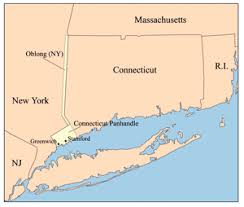
It’s All About the Journey… Did You Know There Is a CT Panhandle?

ct panhandle

Have you ever wondered why Connecticut’s boxlike shape has a jut out into New York?  In life we kind of like things orderly and symmetrical. I’ve recently learned the “tail” is called the Connecticut Panhandle.  Texas, Florida and Oklahoma all have panhandles, but who knew Connecticut has one too!

The Connecticut panhandle is the southwestern portion of Connecticut, where it abuts New York State. It is contained entirely in Fairfield County and includes all of Greenwich, Stamford, New Canaan, and Darien, as well as part of Norwalk and containing some of the most expensive residential real estate in the United States.

The irregularity in the boundary is the result of territorial disputes in the late 17th century, culminating with New York giving up its claim to this area, whose residents considered themselves part of Connecticut, in exchange for an equivalent area extending northwards from Ridgefield, Connecticut, to the Massachusetts border as well as an undisputed claim to Rye, New York.  Just think Playland could have been ours.

The two British colonies (a century before the future Revolution’s end) negotiated an agreement on November 28, 1683, establishing the New York–Connecticut border as 20 miles east of the Hudson River, north to Massachusetts. The 61,660 acres east of the Byram River making up the Connecticut Panhandle were granted to Connecticut, in recognition of the wishes of the residents. In exchange, Rye was granted to New York, along with a 1.81-mile wide strip of land running north from Ridgefield to Massachusetts alongside the New York counties of Westchester, Putnam then Dutchess, known as the “Oblong”.


There is also a little cutout on the Connecticut – Massachusetts border known as either the “Granby Notch” or the “Southwick Jog” depending on which state you’re in.  After a 155 years of border disputes an agreement was reached over the final disputed 2.5 mile area – giving 5/8th’s of the parcel around Congamond Lakes west shore to Massachusetts and Connecticut receiving the remaining east shore, creating the “Notch”.

Let’s save a discussion of Rhode Island and Great Captain’s Island for another day…


Standard
Uncategorized

It’s All About The Journey…Happy New Year!!!

       Is going to Times Square on New Year’s Eve on your bucket list?  I’ve been there and it’s definitely an interesting experience!  I was one of the lucky few that was at a private event (which had a bathroom and was downstairs from Dick Clark’s New Year’s Rockin’ Eve).  Even thought we were inside it was freezing cold (even the alcohol didn’t help), and twenty minutes before the magical hour we were herded like a group of cattle into the “VIP” area where we were squished like sardines.  The ball drop, however, was amazing.

So you may be wondering where the tradition of the Times Square ball drop started.  The history actually centers around the The New York Times moving to its new headquarters in 1903.  The paper’s owner wanted to mark the festivities with a midnight fireworks show, which continued for four years.  In 1907, to draw more attention to the newly renamed Times Square, he had a lighted Ball constructed to be lowered from the flagpole, this was the debut of the Ball drop at one second after midnight.  Though the NY Times later moved its headquarters, the Times Square celebration lives on.

The Ball has transformed from being made of iron and being five feet in diameter, to today’s Ball which is the seventh version, weighing in at 11,875 pounds, measuring 12 ft. in diameter with 2,688 Waterford crystal triangles which vary in size.  The Ball is illuminated by 32,256 LED’s in 672 modules which each contain 48 LED’s – 12 red, 12 blue, 12 green & 12 white – for a total of 8,064 of each color.  The Ball is capable of displaying more than 16 million colors and billions of patterns that creates the spectacular kaleidoscope effect.  WOW!!!

So as you sip your champagne and countdown to midnight you can astonish your friends with your new found knowledge.

Wishing you all a Happy, Healthy & Fun New Year!

Standard
Uncategorized

It’s All About the Journey … Let There Be Lights!


Whether you use colored bulbs or decorate all in white, Christmas lights bring a smile to everyone (maybe even Scrooge).  You may be asking yourself where exactly did the holiday light tradition start?  In the northern hemisphere the winter solstice – the longest and shortest day of the year falls on December 21st this year.  Back in the day many people believed the sun was a god and winter came because the sun god had become sick and weak.  They celebrated the solstice because it meant that the sun god was beginning to feel better.  Evergreen boughs reminded them that plants would grow again when the sun god was strong.

Germany gets the credit for starting the Christmas tree tradition as we now know it and it is believed that Martin Luther first added candles in the 16th century because he was awed by the brilliance of stars twinkling amidst the evergreens and to re-create this beauty he put up a tree in the main room of his house and wired the branches with lighted candles.


The first record of a lit Christmas tree was in the 1830’s by German settlers in Pennsylvania.  Most Americans at this time looked at the trees as Pagan symbols and in 1659 Massachusetts enacted a law making any observance of December 25th, other than church services a penal offense where you were fined for hanging decorations.  This continued until the 19th century when the influx or German and Irish immigrants undermined the puritan legacy.

In the early 20th century with the advent of electricity, (Edison’s assistants came up with the idea of electric lights for trees) Christmas lights became popular and lit trees began to appear in town squares (the Rockefellar Center tree dates back to 1933) and having a tree in your home became an American tradition.


Did you know:

  • In the first week, a tree in your home with consume as much as a quart of water per day.
  • Tinsel was once banned by the government because it contained lead…now it is made of plastic.
  • Franklin Pierce, the 14th president brought the Christmas tree tradition to the White House.
  • More than a million acres of land have been planted with Christmas trees.


Standard
Uncategorized

It’s All About The Journey… The Festival of Lights


For eight days and nights Jewish people around the world celebrate “Hanukkah” which means “dedication”.  The story behind this holiday commemorates the re-dedication of the holy Temple in Jerusalem following the Jewish victory over the Syrian-Greeks in 165 B.C.

The story goes that the Jewish Temple was seized by Syrian-Greek soldiers in 168 B.C. and dedicated to the worship of the god Zeus. In 167 B.C. the Syrian-Greek emperor Antiochus made the observance of Judaisim punishable by death and said all Jews must worship Greek gods.  It got to the point where soldiers were forcing Jews to bow to idols and eat the flesh of pigs, both forbidden by Jewish law.

A Greek high priest, Mattathias, rebelled and after attacking and killing the soldiers in the village of Modiin he and his family, and Jews wishing to fight against the Greeks, went to live in the mountains.  These rebels became known as the Maccabees and ended up victorious in reclaiming their land from the intruders.

After their victory the Maccabees returned to reclaim the Temple in Jerusalem.  In order to purify the Temple they needed to burn the “ritual oil” in the Temple’s menorah for eight days, but only had enough oil for one day.  They lit it anyway and to their surprise the oil lasted the full eight days.

On the first night of Hanukkah and on all other nights during the holiday, the middle candle of the menorah is called a shamash. The shamash does not count as one of the Hanukkah candles, but is used to light all the other candles.  Families usually light their Hanukkah menorah directly or soon after nightfall.

The menorah is set up by placing the candles from right to left. Not counting the shamash, the number of Hanukkah candles in the menorah match the night of Hanukkah. For instance, if it is the 5th night of Hanukkah there would be 5 Hanukkah candles in the menorah.

The shamash is lit first, then the remaining candles from left to right. This is the reverse order of how the candles were placed in the menorah, so the last candle put in the menorah should be lit first. The candles are allowed to burn down and are not extinguished.


Everyone loves a good latke!  These potato and apple pancakes are fried in oil which celebrates the “miracle oil” from back in the day.  Sometimes jelly-filled donuts called sufganiyot are eaten.

What would a celebration be without singing and games?  One of the most popular games involves the dreidel, which is a Yiddish word that comes from the German word “drehen,” which means “to turn.” A dreidel is a four-sided spinning top with a Hebrew letter on each side. It is used to play a popular children’s game that involves spinning the dreidel and betting on which Hebrew letter will be showing when the dreidel stops spinning. Children usually play for a pot of gelt, which are chocolate coins covered in gold colored tin foil.

So light a candle, eat a latke, spin the dreidel and if you’ve been good maybe Hannukah Harry will pay your house a visit if the Mensch on the Bench, a friend of the Elf on Shelf gives you the thumbs up.

Standard
Uncategorized

It’s All About the Journey… So You’ve Decided to Brave Out the Holidays On The Market

You’ve listened to your agent’s advice that listing your home during the holidays can present some advantages – less competition, real buyers & a sense of festivity.  The question becomes how to balance your seasonal decorations while continuing to show your home in the best light possible.

Before doing any decorating make sure your home is spotless and that you’ve done your initial staging by de-cluttering and emphasizing the wonderful space your home offers.

While holiday decorating can be highly personal, this is the year to err on the side of neutral with small subtle touches giving your home a warm and festive feeling.  Also important is to make sure your holiday décor compliments your regular decorating before you start untangling your tinsel.


This is a great opportunity to accentuate some of your home’s highlights such as pretty stockings hanging from your fireplace mantel, showcasing your menorah on the ledge of a bay window or hanging mistletoe in an arched doorway.  On the exterior you can use simple string lighting to highlight your home’s architecture or a beautiful tree in the yard, even though you usually win the neighborhood first prize for flashing lights and the inflatable Santa and his sleigh!

This may be the year to keep extremely religious decorations in storage.  It’s important to be sensitive to potential buyers.  No matter what your religion is, no one is going to feel offended by a nutcracker.

Trees are such an important part of the season and bring a smile to everyone.  Be careful the tree doesn’t take up too much “real estate”.  This is probably the year for a skinny tree.

As always, you need to be careful with valuables. Wrapped presents can be very tempting, especially if young children are looking at homes with their parents.  Save the gifts and surprises for family time.

Last but not least no matter how beautiful your decorations are, the same decorations that made people smile in December will look tired and dated in January.

Bring on the eggnog and enjoy the Holiday Cheer!


Standard
Uncategorized

Gobble…Gobble

The 10 best classic Thanksgiving dishes, ranked


 As we get ready to sit down and gorge on all our favorite foods, (which makes you wonder why we only have them once a year) here’s some food for thought.  So… loosen your belt and read on:

Get over yourself, turkey. You're not all that.

10. Turkey
Some people say turkey is delicious. These people are wrong.  Get over yourself, turkey. You’re not all that.  

We eat turkey at Thanksgiving not because it is the tastiest poultry or the easiest to cook, but possibly because the bird’s large size allows us to feed many hungry people all at the same time.  I don’t know about your house, but no one in my house gives a gobble about turkey until sandwiches the next day!

In fact, baking a turkey is not a labor-intensive exercise.  It does require a few hours but not a lot of practice to do well. Yet most American households only bake one turkey per year. This is why most Thanksgiving birds emerge dry and bland, often requiring the saving graces of gravy. If it weren’t for decades of tradition, you would be hard-pressed to find a household that wouldn’t mind skipping the messy process of prepping and baking a cumbersome turkey.

The exception to this rule is deep-fried turkey, which emerges from the backyard Lazarus pits coated in hot peanut oil a transformed and inarguably more delicious creature. The downside, of course, is that deep-frying a bird carries the risk of setting your home on fire. Such is the nature of turkey: The bad frequently outweighs the good.

9. Corn bread
Simply the best of the breads, all of which otherwise fail to crack the top 10. Corn bread strikes a harmonious balance between sweet and savory that can complement just about anything. The greatest trick the devil ever pulled was convincing the world that rolls are an OK carbohydrate substitute. Don’t be fooled.

8. Green bean casserole
A relic of post-World War II efficiency, the humble green bean casserole was created in the mid-1950s by the Campbell Soup Company. It is a comfort food in the truest sense that accomplishes the improbable: It makes icky green beans palatable. Such innovation is why the casserole has carved out a place for itself in the National Inventor’s Hall of Fame.

7. Mac and cheese
It has been brought to my attention that many households do indulge in the gooey, al dente perfection that is homemade mac and cheese. To which I say: Who knew?

6. Mashed potatoes
You can load them with garlic. Or infuse them with rosemary. If you’d like, you can fashion mashed potatoes into a bed for your turkey, or sculpt them into a concave vessel for gravy. Such versatility is truly American, and should be celebrated as such.

5. Ham
Ham is moist, flavorful, textured, and requires little work to do well. It is the inverse of turkey. Simply rub with brown sugar or bathe it in cola — preferably both. Ham is as under-rated as its cousin bacon is overexposed.

4. Sweet potatoes with marshmallows
Fun fact: Sweet potatoes are a near-perfect health food. They are packed with Vitamin A, B6, and fiber — and can help you lose weight. Realistically speaking you probably won’t — especially with a fluffy bed of marshmallows layered on top. But it’s a comforting thought.

3. Gravy
The gravy boat is the most sought-after dish on the Thanksgiving table. A thick, hearty gravy can save even the blandest of meals. Think of it this way: Would you rather have a carving of turkey breast without gravy, or no turkey at all? The answer should be clear.

2. Stuffing
Turkey merely provides a cavity for stuffing, Thanksgiving’s true centerpiece. Stuffing is a reward, akin to delectable candy packed into a tasteless Butterball piñata. Stuffing is so good, in fact, that we willfully eat it out of the rear end of a dead animal.

1. Pie
Perhaps you are a pecan pie person. Or maybe pumpkin is more your thing. Sweet potato pie is sublime, or apple reminds you it was worth getting kicked out of the Garden of Eden.  All are excellent choices. Each slice is an edible, triangulated vessel for whipped cream, or, if you are ambitious, ice cream. Need to excuse yourself and change into sweatpants? Sure thing. Because pie is the light at the end of the tunnel, the reason we push ourselves and “make room.” Each bit of flaky crust filled with nature’s caramelized sugar is a testament to human perseverance. Pie is a triumph.

Not sure why cranberry sauce didn’t make the cut.  Appears as though mac n’ cheese edged it out.  Maybe a little cranberry mixed with some vodka will get it back in the top 10.

Bon Appetit!


adapted from “The Week”
Standard